


Vertically Aligned Cross-Curricular Curriculum
Explore, connect, thrive.
The YIES curriculum guides children aged 3 to 13 through a continuous, coherent and meaningful educational journey.
Its strength? Linguistic integration.

Ensures educational continuity and progression throughout the 3–13-year-old cycle
Links different disciplines, developing skills that span various fields of knowledge
At every stage, we nurture the 8 key European competences and offer students the opportunity to explore the world through languages, subjects, experiences and contexts rich in specific tools.
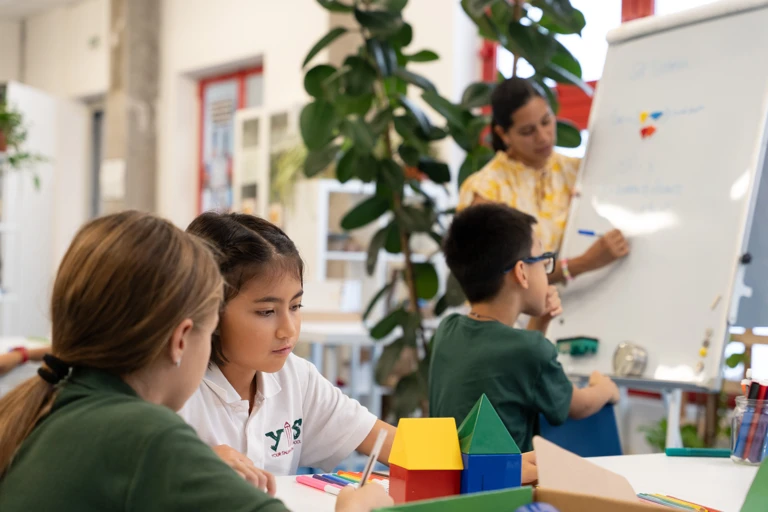
The 8 European key competences
- Communication in one’s mother tongue
- Language skills (foreign languages)
- Mathematical and scientific skills
- Digital skills
- Learning to learn (study method)
- Social and civic skills
- Sense of initiative and entrepreneurship (turning ideas into projects)
- Cultural awareness and expression
Research units and interdisciplinarity
The Investigation Unit is the starting point for all teaching activities.
How does it work? You choose a broad question that serves as an umbrella for the various fields of experience.
These fields of experience are developed within individual disciplines, within a networked model that involves multidisciplinary connections.
This requires ongoing dialogue between teachers and the sharing of concept maps co-created by pupils and teachers.
Assessment tools enable teachers to monitor the progress of individual learners and the achievement of learning objectives. Pupils are also involved through individual self-assessment tools.
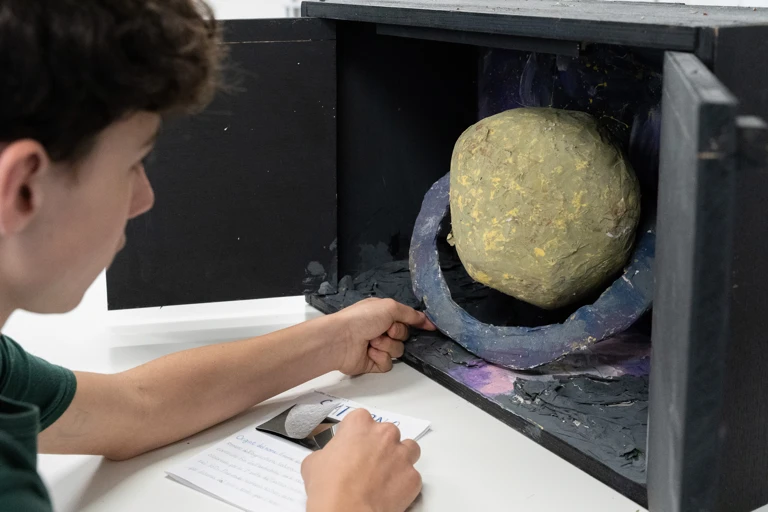
Inquiry Based Learning
The main teaching approach is inquiry-based learning: the children explore phenomena, ask questions, collect data, formulate hypotheses and present their findings.
It is an approach that makes learning more meaningful and relevant to real life.
Study unit: ‘The Human Species’
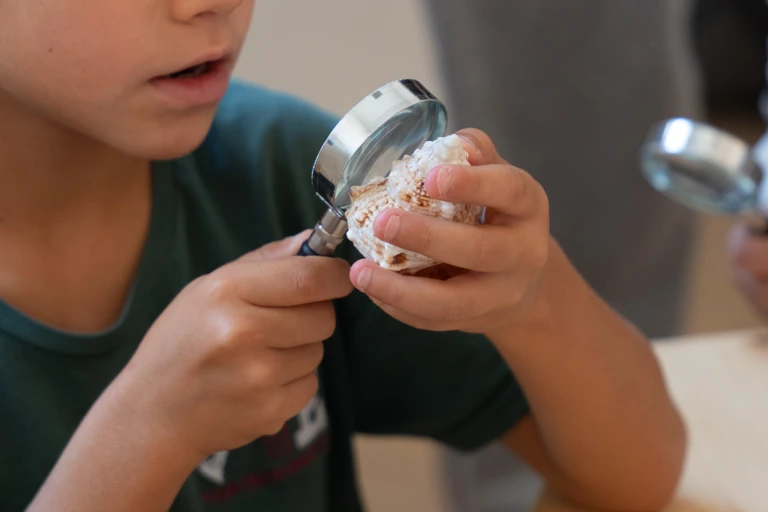
The teachers start a brainstorming session with the children, drawing on their existing knowledge.
Starting from the “we don’t know’s”, a map is constructed that initiates a collaborative inquiry across all disciplinary fields.
Hypotheses are tested through scientific experiments. Theories are set out in writing, documented and discussed in class. In-depth studies draw on literary, poetic, artistic and scientific references.
To support the research ("What makes humans a distinct species?"), we visit exhibitions and museums.
The result of months of work is showcased in exhibitions open to the whole school:
- Notebooks containing research and theories
- Artistic depictions of human evolution
- Comparisons between the respiratory systems of animals, plants and humans
- Survival strategies of different species
Languages: Italian, English and Spanish
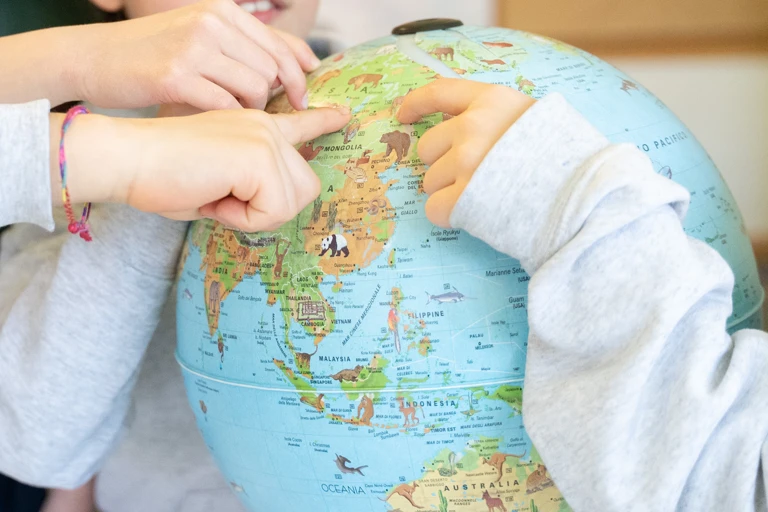
Our language programme is based on Italian-English bilingualism and includes the introduction of Spanish from Primary School.
Language becomes a means of connection, identity and knowledge.
It serves as a vehicle for subject-specific content, complemented by significant efforts to promote general literacy.
This ensures an understanding of how different languages work and enables the competent and informed use of each one.
By the end of the course, the students are able to communicate fluently in the two main languages and know how to make the most of their differences in various contexts.
Learning develops naturally: from preschool routines to immersive activities in primary school, right through to a more structured and interdisciplinary approach in secondary school.
- Italian: reading, writing, listening, comprehension and text production, appropriate vocabulary and different styles (metalinguistics)
- English: everyday and multidisciplinary bilingualism, listening, speaking, writing, activities for the development of metalinguistic skills
- Spanish: introduction of trilingualism from Year 3
IB Program
YIES School è una IB World School. La didattica esperienziale dell’IB è parte integrante del nostro modello educativo.
Alla Primary School offriamo l’IB PYP (Primary Years program) che si configura come modello educativo internazionale e si focalizza sul bambino nella sua totalità.
Cambridge certifications
We prepare Primary and Middle School pupils to sit the Cambridge English exams: a milestone that recognises their communication skills and offers international recognition.
- Training integrated into the timetable
- Progressive courses tailored to age and ability
- Materials and communication activities integrated into teaching
- Development of confidence, independence and language skills
STEAM: Science, Technology, Engineering, Art and Mathematics
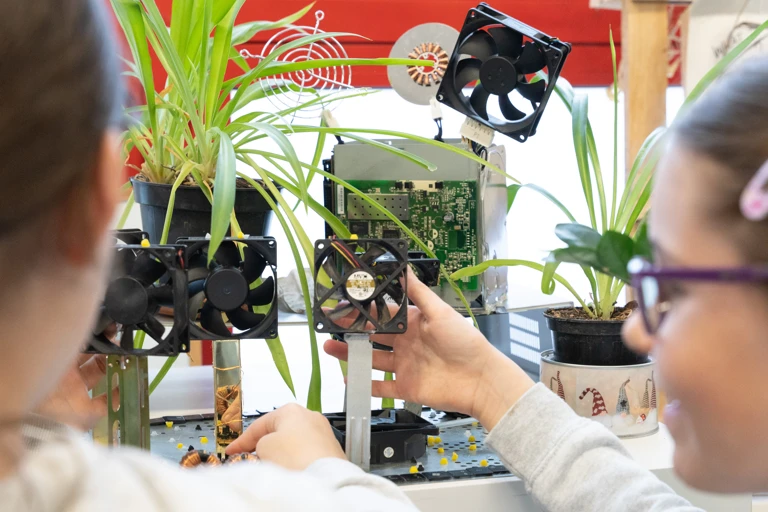
Through our STEAM programme, we integrate science, technology, design, art and mathematics. We encourage observation, creativity, experimentation and design skills.
Through workshops, design challenges and research activities, students learn to observe, experiment, reason and create.
Design thinking helps us find solutions, imagine connections and collaborate.
- Scientific projects and research activities
- Technology workshops, coding and robotics
- Integrated artistic and design experiences
- Concrete, experience-based mathematics
Digital Skills and Coding
Coding introduces students to computational thinking and the logic of digital languages.
Students learn to program, solve problems, develop algorithms and navigate digital environments with confidence.
Study unit 'The Human Species' – Focus on plants
The children observe the differences between the human and plant worlds. The teachers have brought in various species of plants; for several weeks, the children are monitoring their well-being.
What they actually do:
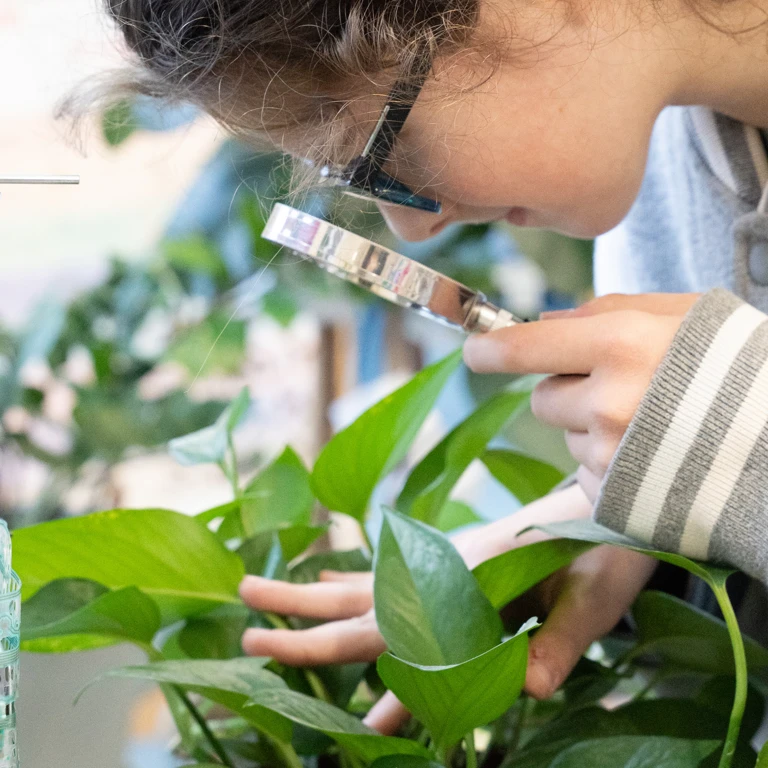
They write comments in their exercise books, in various languages.
They use graphic techniques to depict shapes and shades.
They observe differences and similarities, creating botanical classification schemes (both analogue and digital).
They are building a device to measure the moisture levels in each pot.
In this way, we inspire students by focusing on: Mathematics (measurements), Technology (construction of the moisture detector), Art (lifelike copies of plants), Languages (notebooks for recording investigations), Science (taxonomy and scientific names), Care (responsibility for the plants well-being), Geography (plants places of origin)
SEL: Social Emotional Learning
Through the SEL Workshop, we support children and young people throughout their educational journey, fostering the development of the emotional and social skills needed to feel good about themselves and others.
Recognising emotions, dealing with conflicts, working together, asking for help, and communicating effectively: these are skills that are developed over time through everyday experiences, dialogue and shared reflection.
The programme also addresses the challenges that may arise in their studies and group life. In an atmosphere of mutual understanding, children and young people learn to assess situations, find useful strategies and develop a more mindful approach to difficulties.
Training in emotional intelligence enables students to develop into individuals who are capable of loving themselves and respecting others, even in conflict situations.
The SEL project helps to develop key skills for global citizenship: an understanding of diversity, responsible participation in community life, and a commitment to the common good.
There is a one-hour session with an SEL specialist teacher every week.
What we do during SEL time:
- Circle time and discussion on issues raised by students or teachers
- Discussions on current affairs: “What do you think about…?”, “What would you have done if you were in…’s shoes?”
- Reflection on emotions: “How did you feel? What could you have done differently?”
- Collaboration and shared responsibility (e.g. regarding class rules)
- Non-stereotypical education on diversity and gender
- Practical solutions to the problems raised by the students
Sustainability and the environment
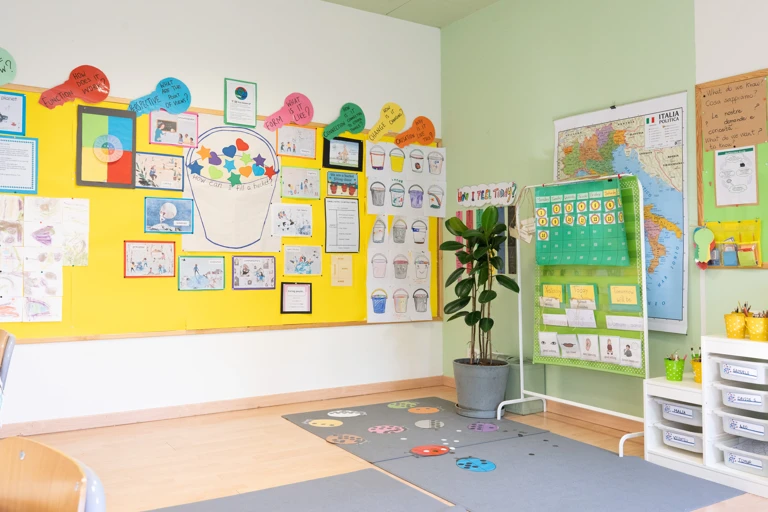
YIES is a Green school. For us, sustainability is not just an additional project, but a way of life at school. We promote responsible behaviour and an ecological culture that combines science, action and awareness.
Children and young people become active agents of change, learning to look after themselves, others and the planet.
The Eco-Schools programme
YIES participates in the international Eco-Schools programme run by the Foundation for Environmental Education (FEE).
Students play an active role in drawing up the action plan: they monitor consumption, put forward ideas, carry out projects and evaluate the results.
The programme encourages initiative, critical thinking and active participation in school life.
Art, Music and Creativity
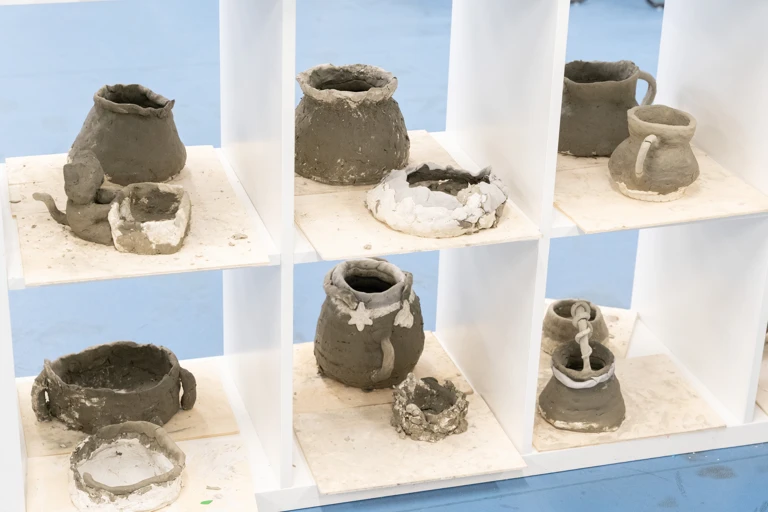
Art and music are forms of expression that enable children to express themselves, imagine, experiment and create worlds. These forms of expression help them to discover themselves and the world around them.
The creative workshops encourage creativity, focus, listening and collaboration. Activities are designed for each age group to explore materials, sounds and shapes.
- Art workshops and experimentation with different materials
- Music, rhythm, listening and singing
- Interdisciplinary projects that bring together different disciplines
Sport and exercise
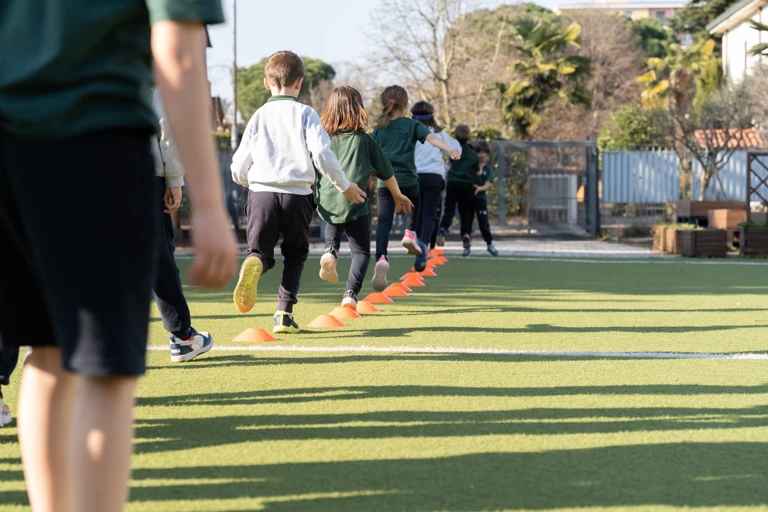
Sport promotes well-being, coordination and positive relationships. Physical activity is an essential part of growing up.
Through physical activities, cooperative games, obstacle courses and sports, pupils develop body awareness, independence and a sense of teamwork.
- Progressive motor skills programmes
- Individual and team sports
- Activities that promote well-being and confidence
Frequently asked questions
The final goal is to nurture not just a competent student, but a wise, independent, and self-aware individual capable of acting responsibly in the global community.
Learning develops naturally, following a “spiral model” where key concepts are revisited over time and explored in greater depth as the student grows. This approach allows for the consolidation of a solid foundation, transforming information into deep and lasting competences.
- In Preschool, children have a balanced 50/50 exposure to Italian and English through routines, games, and songs.
- In Primary School, English becomes an everyday skill used to explore science, art, and literature through an immersive model.
- From Grade 3 (Year 3), Spanish is introduced, leading students toward advanced multilingualism that is completed in Middle School.
Start your journey at Yies
Come discover YIES: book a visit or request information. We look forward to seeing you!